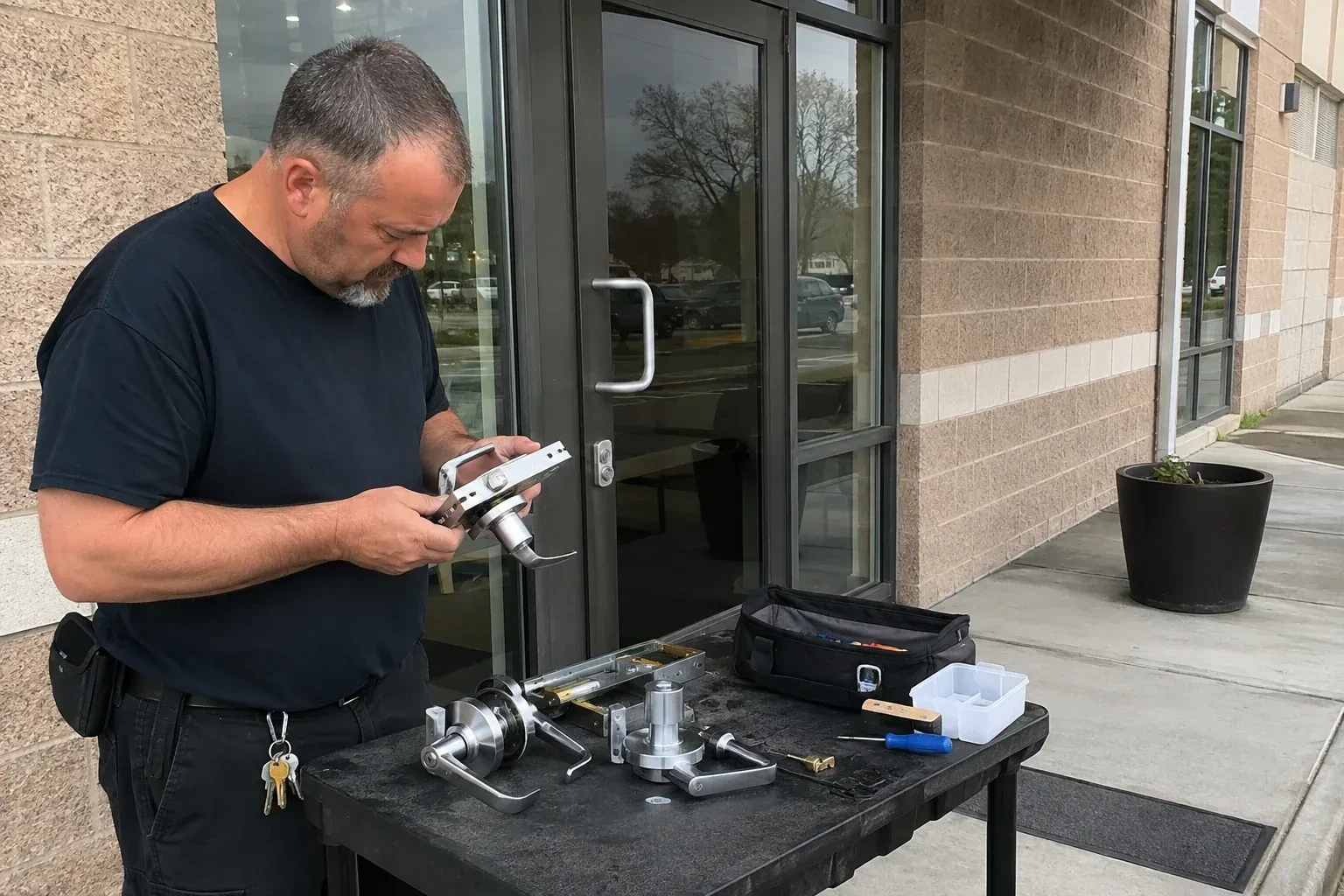
Sound familiar?Sullivan
- The call
- A padlock went on the stockroom's back door years ago for security and nobody has thought about it since, until the walkthrough this week pointed out that the same door is the room's only other way out.
After the fit-out, the gym floor now holds more people than the old office space ever did, and the exit door at the back still has the same turn-lock it had when the room held desks.
The visit ends with a record, not just a working door. Every device fitted is logged with its type, its rating, the force and latch checks it passed, and who now holds the dogging key. That record is what a fire inspector, an insurer or a new property manager asks for later, and it is far easier to hand over on the day of installation than to reconstruct afterward from memory of what went on which door.
Sound familiar?Sullivan
Panic & Exit Hardware · Sullivan
Scene 1
Single doors and pairs get assessed differently from the first look. On a pair, the locksmith checks whether a mullion currently splits the opening, whether a coordinator is already fitted, and whether the leaves close independently or in a set order. This decides whether the project is a straightforward device swap on each leaf or something larger, such as removing a mullion and fitting a compatible replacement latching arrangement to turn two narrow doors into one wide exit. Getting this right at the assessment stage avoids ordering hardware for a single door when the opening is really two leaves working together.
Scene 2
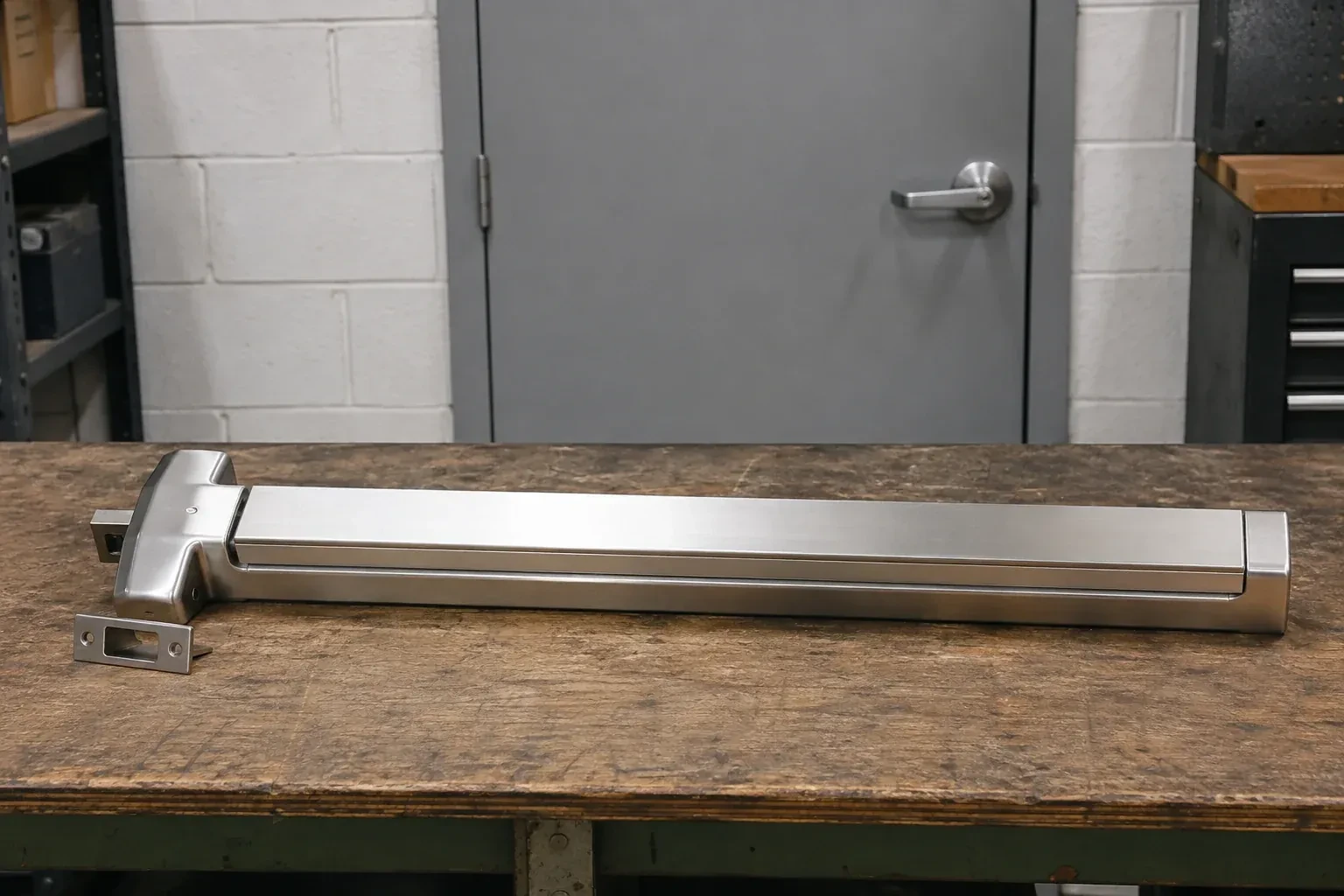
With the assessment done, the locksmith matches a device family to the door: a rim exit device for most single doors, a mortise device where a heavier-duty case suits the opening, or a vertical-rod device where latching is needed at both the top and bottom of the frame. Fire-rated openings take fire exit hardware specifically listed for that duty, never a standard panic device pressed into a role it was not built for, and listed rim fire-exit hardware covers a wide range of those openings on its own. The chosen device is matched to the door's width, handing and existing preparation before it is ordered.
Scene 3
If the space changes use again, adds seating, or the occupant load creeps upward with a future renovation, the hardware fitted now is already suited to a use that requires it, rather than something that will need revisiting the moment the room grows busier. Keeping a note of the occupant load the current hardware was specified for means a future change can be checked against that number before it becomes an inspector's finding rather than a planned upgrade.
What shapes the quoteAgincourt Locksmith Pros
FeesSame any hour
Yes, and it is common. A building rarely has only one exit affected by an occupant-load or fire-rating question; stairway doors, assembly-room exits and any doors altered together during a renovation are usually assessed and fitted in the same visit, with one written record covering every device installed across the building.
The device and trim choices are the same, but a retrofit usually has to work with a door and frame that already carry someone else's old hardware preparation. Reading what holes and reinforcement already exist, and choosing a device that can use or cleanly replace them, is a bigger part of a retrofit than of a new opening built with the hardware in mind from the start.
Hardware standards set a maximum, not a target: an exit device is built to release the latch under a firm push, no more than about 15 pounds of force applied at the touchpad or crossbar, roughly the pressure of a light shove rather than a heave. That ceiling covers people who cannot lean hard into a door, so the swing stays open to anyone moving toward it under pressure.
TorontoOntario
Panic & Exit Hardware · Toronto, Agincourt, Agincourt North, Clarks Corners, Tam O'Shanter
Every square is one home in a hundred.
On-site assessment
After the fit-out, the gym floor now holds more people than the old office space ever did, and the exit door at the back still has the same turn-lock it had when the room held desks.
(289) 806-4250, open 24/7.
On-site assessment preferred · (289) 806-4250, open 24/7